Knowledge Bases and Document Chat
Use Knowledge Bases to ask questions across PDFs, documents, and other files in Open WebUI. Upload your files, attach the collection to a model or conversation, and ask a question. Where document content is processed depends on your extraction, embedding, and model providers; see Chat Data Privacy & Encryption.
Ask your first document question
Start with a running Open WebUI instance, a connected model, and permission to create knowledge bases and upload files. For focused retrieval, use a model that supports Native function calling, with Builtin Tools and the Knowledge Base tool category enabled. Native is the default mode; the model must use its tools to retrieve attached knowledge.
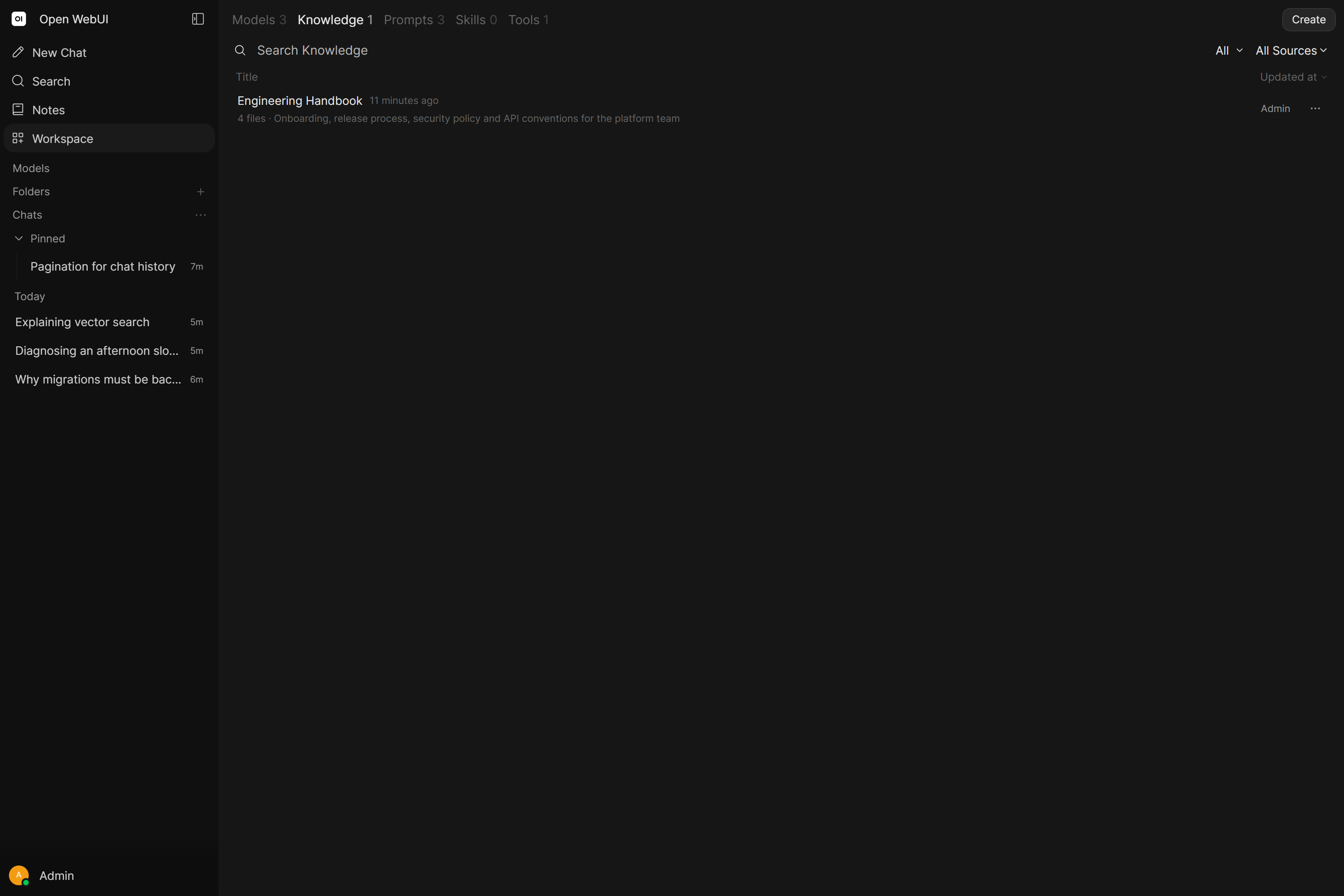
- Click Workspace > Knowledge, then Create. Give the knowledge base a name and description.
- Upload a small text-based PDF or text file. Wait for processing to finish before asking about it.
- Reference the knowledge base in chat with
#, or attach it to a model in Workspace > Models > Edit and start a conversation with that model. - Ask a question whose answer is in the file, such as: "Use the attached handbook to find the office opening hours. Quote the relevant passage."
- Compare the answer and any source references with the original document. If the model cannot find the content, follow Knowledge Base troubleshooting.
Choose how to work with files
| Need | Use |
|---|---|
| Ask about one file in one conversation | Upload a file to the chat |
| Reuse a document collection across conversations | A Knowledge Base, using the steps above |
| Analyze spreadsheets or create files through code | Open Terminal's file-analysis guide |
Unlike Notes, which inject full content into every message, Knowledge can retrieve relevant passages on demand. This makes it useful for document sets that would exceed the model's context window if sent in full. For local-only document chat, also follow Run Open WebUI Offline.
Why Knowledge?
Your documents become searchable by AI
Upload a folder of contracts, technical specs, or research papers. The AI searches them by meaning, not just keywords, and cites where it found the answer.
Two retrieval modes for different needs
Choose Focused Retrieval (RAG) to let the AI search large collections efficiently, or Full Context to inject an entire document word-for-word when precision matters.
Autonomous exploration with native function calling
With native function calling enabled, models don't just search. They browse your knowledge bases, read files page by page, and synthesize across multiple documents without manual prompting.
Scoped access keeps things organized
Attach specific knowledge bases to a model so it only searches what's relevant. Or leave it unscoped and let the model discover everything the user has access to.
Key Features
| 📄 13 vector databases | ChromaDB and PGVector (officially maintained), plus non-core integrations: Qdrant, Milvus, OpenSearch, Elasticsearch, and more |
| 🔍 Hybrid search | BM25 keyword search + vector search with cross-encoder reranking |
| 📑 8 extraction engines | Tika, Docling, Azure, Mistral OCR, Datalab Marker, MinerU, PaddleOCR, custom loaders |
| 🤖 Agentic retrieval | Models browse, search, and read your documents autonomously |
| 📄 Full context mode | Inject entire documents with no chunking |
| 🗂️ Nested directories | Organize files into subdirectories with drag-and-drop reordering |
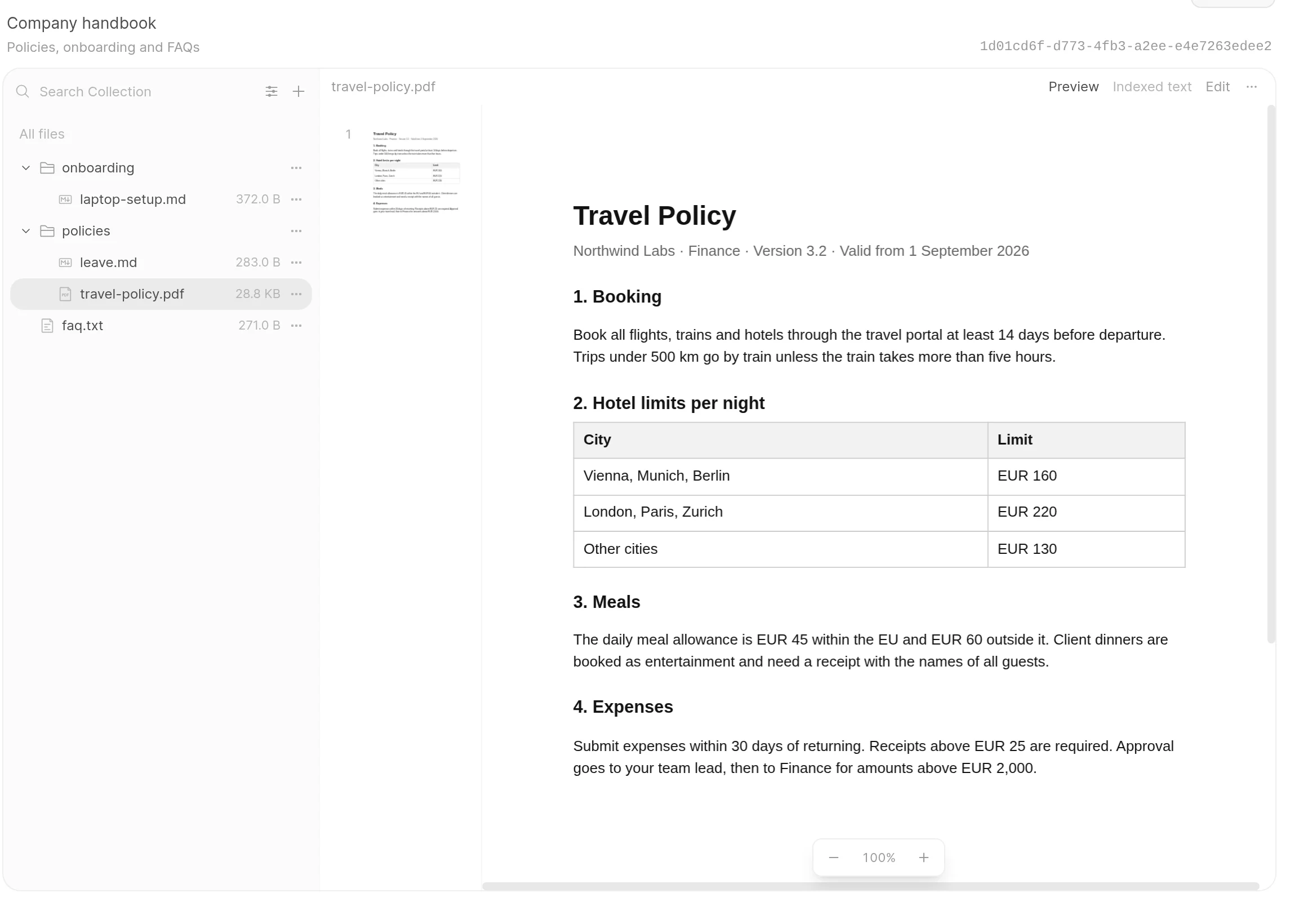
| 👁️ File browser with preview | Browse files in a tree, preview the original file next to the list, and read or edit the indexed text the AI searches |
| 🔄 Incremental directory sync | Mirror a local folder into the KB, only new and modified files upload, deletions are removed, folder structure preserved. Mirror remote sources too (Git, Confluence, S3 and more) with oikb |
| 📦 Export and API | Back up knowledge bases as zip files, manage via REST API |
Retrieval Modes
When attaching files or knowledge bases to a model, click on the attached item to toggle between modes:
In the preview that opens, the knowledge base's name opens it in the workspace, and a file or link name opens the file or page. Both open in a new tab.
🔍 Focused Retrieval (default)
Uses RAG to find and inject the most relevant chunks based on the user's query. When hybrid search is enabled (ENABLE_RAG_HYBRID_SEARCH), retrieval combines BM25 keyword search with vector search, plus reranking for accuracy.
Best for large document sets where only specific sections are relevant.
📄 Full Context
Injects the complete content of the file into every message. No chunking, no semantic search. For files and collections attached in the chat it is injected whatever the function calling mode, so the model needs no tool to reach it. A knowledge base attached to the model, though, is only injected in legacy function calling mode: with native function calling the model reaches model-attached knowledge through the knowledge tools, Full Context or not.
Best for short reference documents, style guides, or context that's always relevant.
Agentic Knowledge Tools
With native function calling enabled, models interact with your knowledge bases using built-in tools. Which tools appear depends on whether specific knowledge is attached to the model:
| Tool | Attached KB | No KB attached | Description |
|---|---|---|---|
list_knowledge | ✅ | ❌ | List attached KBs (with file counts), standalone files, and notes; pass knowledge_id (with skip/count, max 200) to page one KB's files |
list_knowledge_bases | ❌ | ✅ | Browse available knowledge bases with file counts |
search_knowledge_bases | ❌ | ✅ | Find knowledge bases by name or description |
query_knowledge_bases | ❌ | ✅ | Search KB names/descriptions by semantic similarity |
search_knowledge_files | ✅ (scoped) | ✅ (all) | Search files by filename |
query_knowledge_files | ✅ (scoped) | ✅ | Search file contents using the RAG pipeline |
grep_knowledge_files | ✅ (scoped) | ✅ | Exact text / regex search across knowledge files (returns matching lines with line numbers; auto-detects regex like `error |
view_file | ✅ | ❌ | Read file content with pagination (offset/max_chars) or by line range (start_line/end_line, optional line_numbers) |
view_knowledge_file | ✅ | ✅ | Read file content from any accessible KB |
view_note | ✅ | ❌ | Read attached notes |
"Attached" here covers knowledge on the model, knowledge on the chat's folder, and knowledge bases or notes attached to the chat itself when the model's File Context capability is off. Whatever the source, the model is told what it has: its system prompt carries an <attached_knowledge> list of the items with their IDs, so it can point a query at one knowledge base rather than searching blind.
The key split: list_knowledge and list_knowledge_bases are mutually exclusive. Attaching a KB scopes the model to only those documents. Leaving it unscoped lets the model discover everything the user has access to.
When to prefer grep_knowledge_files over query_knowledge_files
The two search tools complement each other:
query_knowledge_files | grep_knowledge_files | |
|---|---|---|
| How it matches | Semantic / vector retrieval (with optional BM25 + rerank when ENABLE_RAG_HYBRID_SEARCH is on) | Exact string match, regex auto-detected (e.g. error|warn, version \d+) |
| Returns | Relevant chunks of content | Matching lines with file ID, filename, and 1-indexed line number |
| Use when | "What does the documentation say about X?" for paraphrased questions, conceptual lookups | "Find every place we mention OPENAI_API_KEY" for literal identifiers, error strings, version numbers |
| Result cap | The tool's own count argument, which the model sets (default 5). The admin Top K setting does not apply here | 50 matches (KNOWLEDGE_GREP_MAX_MATCHES) |
| Flags | (none) | case_insensitive, count_only, file_id (single-file mode) |
In agentic flows, a typical pattern is: query_knowledge_files to locate the relevant document, then grep_knowledge_files to pinpoint exact lines, then view_file (line-range mode below) to read the surrounding context.
Reading with view_file
view_file supports two addressing modes:
- Character pagination:
offset+max_chars(default10000, hard cap100000; both configurable withVIEW_FILE_DEFAULT_MAX_CHARSandVIEW_FILE_MAX_CHARS). Best for streaming through a long document; the response includesnext_offsetwhen the file is truncated. - Line range:
start_line+ optionalend_line(1-indexed, inclusive). Overridesoffset/max_charswhen set; pairs naturally withgrep_knowledge_files' line numbers. Passline_numbers: trueto also get a<n>: <line>prefix on each returned line.
The line-range response includes total_lines, showing_lines, and next_start_line for follow-up reads.
Filesystem-style access (kb_exec)
When ENABLE_KB_EXEC=True is set, Open WebUI exposes a kb_exec tool that gives the model a filesystem-style interface over knowledge bases.
Tools that go away, because their function is now covered by kb_exec commands:
list_knowledge: replaced bylssearch_knowledge_files: replaced byfind "<glob>"grep_knowledge_files: replaced bygrep "<pattern>"view_fileandview_knowledge_file: replaced bycat,head,tail,sed -n '<a>,<b>p'
Tools that stay injected alongside kb_exec, because they do something kb_exec can't:
query_knowledge_files: semantic / RAG search (always)view_note: when notes are attached to the model (kb_execis file-only, so notes need a dedicated reader)query_knowledge_basesandsearch_knowledge_bases: when no KB is attached to the model, so the model can still discover and search across knowledge bases by name/description
It is off by default and still experimental, but for an enhanced agentic RAG experience we recommend enabling it (ENABLE_KB_EXEC=True) for capable models running native function calling. It targets frontier models that already "think in shell": they tend to chain ls, grep and cat more reliably than they orchestrate a fan-out of specialized tools. It only works with native function calling on; for models set to Legacy it has no effect.
Supported commands
| Command | Purpose |
|---|---|
ls, ls <dir>/, ls -a | List the current level / a subdirectory / a flat view of every file with full paths |
ls -t, ls -S, ls -r | Sort the listing: newest first, largest first, or reverse whichever order is in effect |
tree, tree <dir>/ | Recursive directory tree |
cat -n <file> | Read a file (optionally with line numbers) |
head -N <file> / tail -N <file> | First or last N lines |
sed -n '<a>,<b>p' <file> | Print lines <a> through <b> |
grep "<pattern>" [<dir>/|<file>|*.ext] | Exact / regex search; flags -i (case-insensitive), -l (filenames only), -c (counts) |
find [<dir>/] "<glob>" | Find files by glob, and it takes the same sort flags as ls |
wc <file> | Line / word / char counts |
stat <file> | File metadata |
Pipes
kb_exec parses a single pipeline, so commands compose:
grep "auth" | head -5
grep -l "TODO" docs/
find docs/ "*.md" | head -10
File references
Files can be addressed three ways, pick whichever is unambiguous:
- Path:
docs/api/auth.md(relative to the knowledge base root; resolves through the directory tree) - Filename:
auth.md(errors with an "ambiguous filename" hint when the same name exists in multiple directories or KBs) - File ID: the UUID returned by
ls,find, orgrep
Sorting
ls, find and tree list files by path, so a listing is stable and comparable between calls. Three flags change that: -t puts the most recently updated first, -S puts the largest first, and -r reverses whichever order applies, so ls -tr is oldest first. They combine with everything else, for example ls -a -t or find docs/ "*.md" -S.
Asking "what changed lately" in a knowledge base of a few thousand files is ls -a -t | head -20 rather than reading the whole listing.
Behavior notes
kb_execrespects the same access control as the other knowledge tools: files the user can't read are silently excluded from results.- Output is bounded per call. One command returns at most 30,000 characters (
KB_EXEC_MAX_OUTPUT_CHARS), whatever produced them, and the model is told to narrow the command when it hits the limit. This is a single budget for the whole pipeline, so acatof a large file and a widegrepare capped the same way. - A wide
grepis refused rather than run. Searching more than 200 files (KB_EXEC_MAX_GREP_FILES) returns a prompt to scope the search to a directory or glob, andgrepreturns at most 50 matching lines (KNOWLEDGE_GREP_MAX_MATCHES), the same capgrep_knowledge_filesandgrep_chat_filesuse. - The model still has
query_knowledge_filesfor semantic search; reach for it when literal commands won't find a paraphrased concept. - Built on top of the directory model.
kb_execis the only tool that fully reflects the directory structure created in the UI.
Autonomous exploration works best with frontier models that can intelligently chain search, browse, and synthesize. Smaller models may struggle with multi-step retrieval. Administrators can disable the Knowledge Base tool category per-model in Workspace > Models > Edit > Builtin Tools.
Guiding tool choice across mixed knowledge bases
With kb_exec enabled, the model picks between two complementary tools, and the simplest way to make it reach for the right one per knowledge base is a short system prompt that names the bases and the tool to favour:
- Prose and PDFs suit
query_knowledge_files(semantic search). It matches on meaning, so it handles paraphrased questions over documents well and does not depend on clean text extraction. - Text files, code, configs and logs suit
kb_exec(ls,tree,grep,cat, read-by-line). The model can walk the tree and pull exact lines, which beats semantic search for literal identifiers, error strings and structure.
A prompt that spells this out per base biases the model correctly while still letting it decide each call:
Two knowledge bases are attached. Handbook is PDF documentation: use
query_knowledge_filesfor questions about it. Codebase is source files: usekb_exec(grep,cat,ls) to find and read exact code. In general, preferkb_execfor exact strings, identifiers and file structure, andquery_knowledge_filesfor conceptual questions.
Without kb_exec, the same split applies between grep_knowledge_files and query_knowledge_files.
For the full list of built-in agentic tools, see the Native/Agentic Mode Tools Guide.
When native function calling is enabled, attached knowledge is not automatically injected. The model must call the knowledge tools to search and retrieve. If your model isn't using attached knowledge:
- Add system prompt instructions telling the model to use
list_knowledgeandquery_knowledge_files. - Check the model's tool capabilities and retrieval setup using Knowledge Base troubleshooting. Keep Native mode enabled and use a model that can call tools reliably.
- Switch to Full Context mode for the attachment to bypass RAG entirely.
Setting Up a Knowledge Base
For the initial create, upload, and chat steps, see Ask your first document question. The sections below cover managing the collection after setup.
Once you have more than a handful, the list can be reordered by clicking the Title or Updated at column headers. Clicking the header you are already sorted by reverses the direction. The list starts on Updated at, newest first.
To change who can see or edit a knowledge base, open the three-dot menu on its row and choose Access. This opens the access settings directly, without opening the knowledge base, and every change saves as soon as you make it. Admins see the menu on every knowledge base; other users see it on the ones they can edit. Resource Access explains visibility and access grants.
Browsing and previewing files
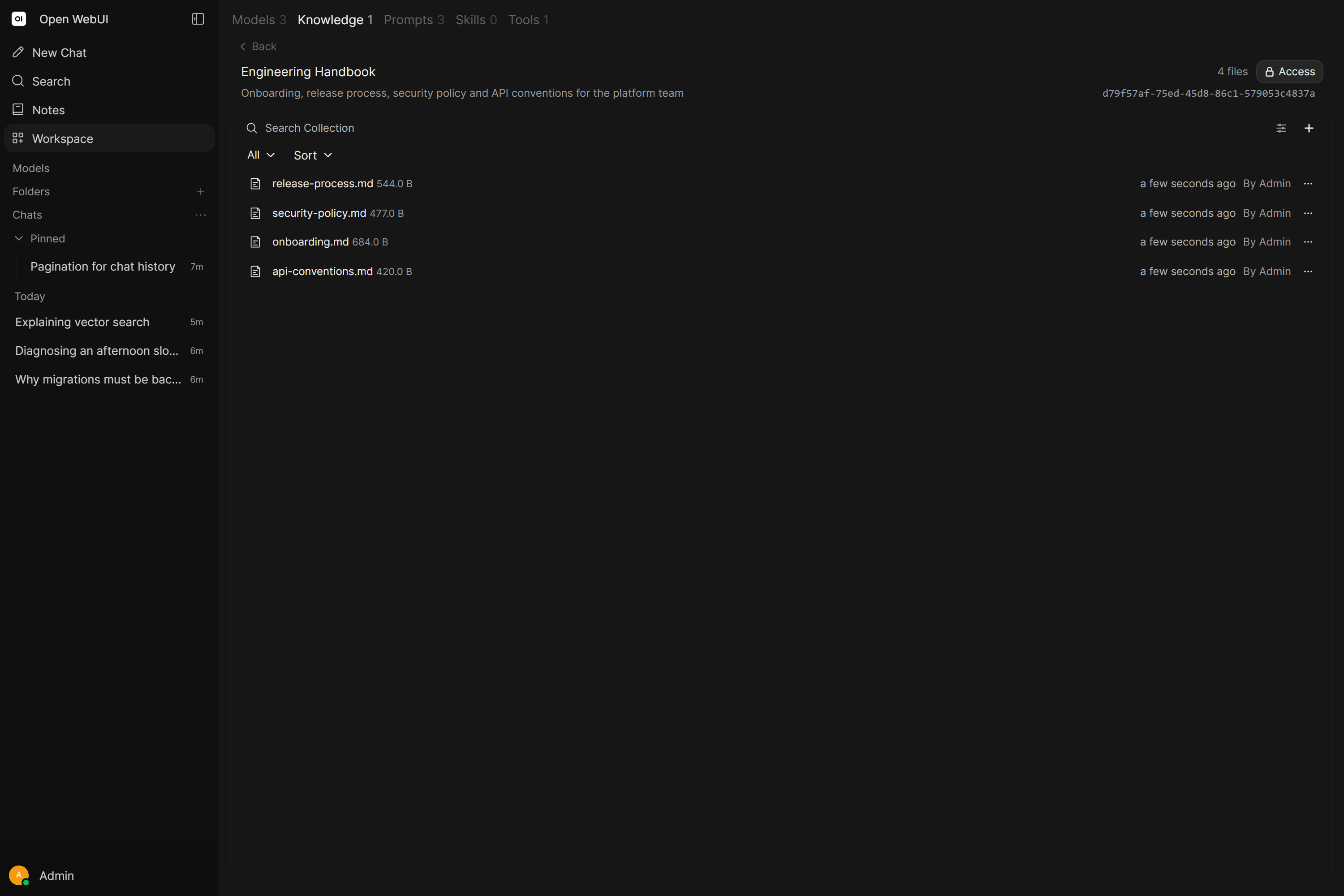
Opening a knowledge base shows its files as a tree on the left and a preview pane on the right. Click a file to open it in the preview; on small screens the preview slides in over the list. Drag the divider to make the file list wider or narrower.
The preview has two views, switched with the buttons above it:
- Preview shows the original file as it was uploaded: PDFs, images, audio, video, Word documents, Excel workbooks (with a sheet picker), PowerPoint slides and text-based files such as Markdown, code, CSV, JSON and HTML. For formats with a rendered view, such as Markdown, CSV, JSON, HTML and SVG, the ⋯ menu switches between View source and Rendered preview.
- Indexed text shows the text Open WebUI extracted from the file. This is what retrieval and the knowledge tools search, so it is the place to check when an answer misses something that is in the document.
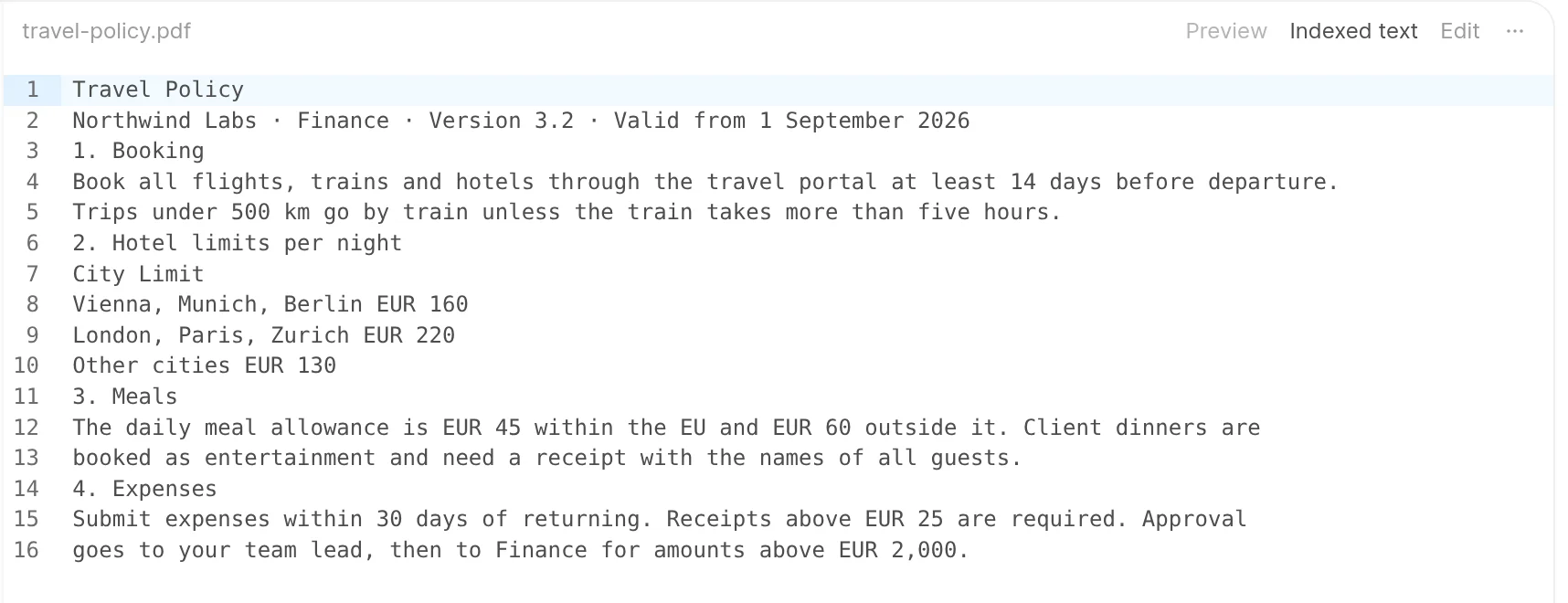
If the original file is not available, for example because only its text was stored, the file opens on Indexed text and the Preview button is hidden.
Editing the indexed text
With write access, click Edit to change the indexed text, then Save (or Cancel). Saving processes the new text again and updates every knowledge base that contains the file, so retrieval uses your corrected text. The original file stays as it was. If processing the text fails, or the text is saved but some knowledge bases could not be updated, an error message says so; save again to retry.
While you have unsaved edits, opening another file, closing the preview, deleting an item, syncing, resetting or leaving the page asks Discard unsaved changes? first.
Downloading
Download sits in the ⋯ menu of the preview and in the three-dot menu of each file row. It saves the original file. For a file that opens on Indexed text because its original is not available, Download saves the indexed text as a .txt file.
Search, filter and sort
The Search Collection box above the tree searches the whole knowledge base by file name, and results inside a folder show the folder path next to the name. The filter button next to it offers:
- Search file content: also match the indexed text inside files. Very large files are searched up to a character limit (
RAG_FILE_CONTENT_SEARCH_MAX_CHARS). - All, Created by you or Shared with you: limit the list by who added the file.
- Name, Created or Updated, with Ascending or Descending: the sort order. The default is Updated, newest first.
Organizing into directories
Knowledge bases support nested directories so larger document sets stay navigable. Create them from the Add Content menu (New directory), then reorganize freely.
Creating and navigating
- New directory lives in the Add Content menu (the + button next to the search box), which also offers Upload files, Upload directory, Sync directory, Add webpage, Add text content and Reset (which removes every file from the knowledge base). Type the name in the new row and press Enter. Name uniqueness is enforced per parent: two siblings can't share a name, but you can reuse names in different parents.
- Click a directory to expand or collapse it in the tree. The three-dot menu on a directory row adds content straight into that directory: New folder, Upload files, Upload directory, Add text content and Add webpage.
- Directories can be renamed or moved to a different parent without affecting the files inside them.
Drag-and-drop
You can move items by dragging:
- Files onto a directory row, or onto the All files label at the top of the tree to send them back to the top level.
- Directories onto another directory to nest them, or onto All files to move them to the top level. Moving a directory into itself or one of its descendants is blocked server-side.
Deletion semantics
Deleting a directory opens a dialog titled Delete directory? with one checkbox, Delete all contents inside this directory:
- Checked (the default): the directory, its subdirectories and every file inside them are removed from the knowledge base.
- Unchecked: the directory and its subdirectories are removed, and every file inside them, at any depth, moves into the deleted directory's parent (or the top level).
Effect on retrieval and tools
- Retrieval and standard RAG still span the entire knowledge base. Directories don't shard the vector index; chunks from any subdirectory remain reachable in a single search.
- Agentic tools are directory-aware:
kb_exec(when enabled) treats subdirectories like a filesystem:ls docs/,tree,grep "x" docs/, and path-style refs (docs/api/auth.md) all work. See Filesystem-Style Access (kb_exec) below.- The other knowledge tools (
query_knowledge_files,grep_knowledge_files,search_knowledge_files) ignore directory boundaries and return matches from the whole KB.
Renaming files
Individual files can be renamed in place from the workspace via the file's item menu, no need to re-upload. The new name is reflected everywhere the file is referenced (knowledge listings, agentic tool output, citations).
Syncing a local directory
The Add Content → Sync directory action mirrors a local folder into the knowledge base incrementally: the client hashes each local file (SHA-256), the server compares hashes and paths against what is already stored, and only new, modified, and deleted files are touched. Unmodified files (the typical majority) are left alone: no re-upload, no re-embedding. The local folder's subdirectory structure is mirrored in the KB; missing subdirectories are created, and subdirectories that no longer exist locally are removed.
The in-app Sync directory runs in your browser: it enumerates, hashes and uploads every file client-side. That is fine for a modest folder, but on a large set (thousands of files or a multi-gigabyte vault) it gets slow and gives little progress feedback, often sitting for a long time before it even reports the file count. For large or frequently-changing libraries we strongly recommend the official Knowledge Base Sync (oikb) tool instead: it runs natively with progress bars, parallel uploads and retries, built for exactly this. Point it at the top of your folder and it syncs the entire tree (every subdirectory, recursively) into one Knowledge Base.
Behavior to be aware of:
- Hidden files and folders (anything beginning with
.) are skipped. - Files modified locally upload with a new content hash; the old file entry is removed from the KB and replaced.
- Files removed locally are deleted from the KB during the cleanup step.
- The action is non-destructive for unchanged files. Earlier versions of the same menu action used to wipe and re-upload everything; that is no longer the case as of v0.9.6.
For programmatic use, the same workflow is exposed as two endpoints under API access below.
The in-app Sync directory action handles a local folder on your machine. To mirror a remote source instead (a GitHub repo, a Confluence space, an S3 bucket and dozens more), or to keep a Knowledge Base current automatically on a schedule or on every push, use the official Knowledge Base Sync (oikb) companion tool. It drives these same endpoints for you.
Exporting
Admins can export an entire knowledge base as a zip file via the item menu (three dots) > Export. Files are converted to .txt for universal compatibility. Regular users will not see the Export option.
API access
Knowledge bases can be managed programmatically:
Files
POST /api/v1/files/: Upload files. Passknowledge_id(and optionallydirectory_id) in the upload metadata to have the backend auto-link and process the file into that knowledge base server-side, equivalent to a follow-upPOST /api/v1/knowledge/{id}/file/add, but it does not depend on the client staying connected after upload. This is the recommended single-call path (added in v0.9.6, fixing files left unlinked when the uploader disconnected mid-processing). The server SHA-256-hashes the uploaded bytes intofile.meta.file_hash; clients can pre-compute and sendfile_hashin metadata to skip server-side hashing (used by the incremental sync flow below).GET /api/v1/files/{id}/process/status: Check processing statusPOST /api/v1/files/{id}/rename: Rename a fileGET /api/v1/files/{id}/content: Download the original file. Returns 404 withOriginal file is unavailable.for a file stored as text only.GET /api/v1/files/{id}/content/{file_name}: Download the file as an attachment. When the original upload is missing, it returns the indexed text as plain text.GET /api/v1/files/{id}/data/content: Read the indexed textPOST /api/v1/files/{id}/data/content/update: Replace the indexed text (body:content) and reprocess it in every knowledge base that contains the file. Returns 500 when processing fails, or when the text was saved but some knowledge bases could not be reindexed; send the request again to retry.POST /api/v1/knowledge/{id}/file/add: Add files to a knowledge base. A file whose extracted text is already in the knowledge base is rejected withDuplicate content detected. Please provide unique content to proceed.POST /api/v1/knowledge/{id}/files/batch/add: Add several files at once. The same duplicate check applies: a duplicate is reported as a failed file and the other files are still added. Content batch-added before v0.12.0 has no content hash and is not detected as a duplicate.POST /api/v1/knowledge/{id}/file/move: Move a file between directories within the same KB (body:file_id,directory_id, wherenullmoves to the KB root)
Directories
POST /api/v1/knowledge/{id}/dirs/create: Create a directory (body:name, optionalparent_id)POST /api/v1/knowledge/{id}/dirs/{dir_id}/update: Rename or re-parent a directory (body:nameand/orparent_id)DELETE /api/v1/knowledge/{id}/dirs/{dir_id}/delete?move_files=true: Delete a directory. Withmove_files=true(default), contained files are re-parented; withmove_files=false, they're deleted along with the directory.
Incremental directory sync (added in v0.9.6)
POST /api/v1/knowledge/{id}/sync/diff: Submit a local manifest (manifest: [{path, filename, checksum}]wherechecksumis the SHA-256 of the file bytes) and receive{added, modified, deleted, mkdir, rmdir, unmodified_count}describing exactly what to upload, replace, delete and which directories to create/remove. Read-only, does not mutate the KB. A file uploaded to the KB less than an hour ago that is still pending or processing counts as unmodified when its path, name and checksum match, so a second sync does not upload it again. After an hour it is offered for upload again.- After acting on the diff (create
mkdirpaths, uploadadded+modifiedfiles with their hashes viaPOST /api/v1/files/), call: POST /api/v1/knowledge/{id}/sync/cleanup: Body:{file_ids: [...], dir_ids: [...]}. Removes the stale files (from the KB, vector store and per-file collections) and the now-empty directories returned bysync/diff. Run this last so deletions don't outrun uploads.
File processing happens asynchronously. You must poll the status endpoint until processing completes before adding files to a knowledge base, or you'll get an "empty content" error. See API Endpoints for workflow examples.
Use Cases
Project documentation
Upload your team's technical specs, architecture docs, and runbooks into a knowledge base. Attach it to a "Project Assistant" model. The AI answers questions grounded in your actual documentation instead of generic training data.
Legal and compliance review
Load contracts, policies, and regulatory documents. Ask the AI to find specific clauses, compare terms across agreements, or flag inconsistencies.
Research synthesis
Add dozens of papers to a knowledge base. The AI searches across all of them to answer questions, find supporting evidence, or identify contradictions between studies.
Limitations
Context window with Full Context mode
"Using Entire Document" injects the full text. A large document attached to a model with a small context window will crowd out conversation history.
Processing delay for API uploads
Files uploaded via API are processed asynchronously. Attempting to use a file before processing completes will fail silently or return empty results. Note that uploading with a knowledge_id (above) makes linking server-side and robust to client disconnects, but it does not make the content instantly queryable: extraction/embedding still runs in the background, so poll GET /api/v1/files/{id}/process/status before relying on retrieval.
Native function calling changes behavior
Native function calling is now the default, and it changes how knowledge bases work: attached KBs are no longer auto-injected, so the model must call the knowledge tools to retrieve them. See Knowledge Base troubleshooting for details.