Astellas Employees Build 420+ Custom AI Models on a Secure, Self-Hosted Platform with Open WebUI
Overview
How Astellas Pharma Inc. built a secure, flexible internal AI platform with Open WebUI on Azure, enabling 3,000+ employees to create, customize, and share generative AI models. Users organically built 420+ custom models and reported a +43 NPS across the organization.
At a Glance
- Users: 3,200+ total; 800+ advanced users with access to frontier models
- Region: Global (headquartered in Tokyo, Japan)
- Industry: Pharmaceutical
- Deployment: Azure AKS (private endpoints)
- Models: Azure OpenAI, Gemini, DeepSeek, Perplexity
- Time-to-deploy: ~1 month (April to May 2025)
- Adoption: 30 to 40% weekly active users sustained over five months
- Key Results: 420+ custom models created, 68% of users report significant efficacy gains, +43 NPS
About Astellas Pharma Inc.
Astellas Pharma Inc. is a global life sciences company engaged in the research & development, sales & marketing, and manufacturing of prescription drugs. With operations in roughly 70 countries and nearly 20,000 employees and contractors, Astellas is driven by a mission to turn innovative science into VALUE for patients worldwide.
The Challenge: Flexible, Secure AI Without Vendor Lock-In
As generative AI capabilities advanced rapidly, Astellas needed a platform that could keep pace, without tying the organization to a single model provider. The company operates across dozens of countries, manages complex regulatory landscapes, and supports scientific workflows that span multiple languages and disciplines. Third-party SaaS tools offered limited integration options, restricted customization, and lacked the security and compliance controls a global pharmaceutical company requires.
The goal: deploy a secure, self-hosted AI platform that gave every department, from R&D and Clinical Development to Pharmacovigilance and Compliance, the flexibility to leverage cutting-edge models while maintaining full control over security, compliance, and data governance.
Key Requirements
- Flexible model selection: freedom to choose and switch between providers
- Option to use locally-hosted models for sensitive analysis
- Capability to create custom models tailored to specific workflows
- Secure sharing and joint development of models within defined groups
- Technical integration with internal and external systems
The Solution: Open WebUI on Azure
Open WebUI was selected for its flexibility, fine-grained permission controls, and scalable architecture, allowing Astellas to host entirely within their secured private environment while supporting both custom model creation and group-based collaboration.
Architecture Highlights
- Compute / Orchestration: Kubernetes (AKS) cluster with autoscaling based on demand
- Storage / Database: Azure Database for PostgreSQL (encrypted at rest; backups aligned to internal policy)
- Networking: VNet-isolated; Application Gateway with private endpoints for LLM APIs
- Secrets: Azure Key Vault integrated with Open WebUI for secure credential management
- CI/CD: Azure DevOps pipelines for upgrades, configuration deployment, and governance controls
- Logging / Monitoring: API Management Service, Azure Dashboards, Databricks
- Security Controls: MFA via IdP, RBAC by group, data residency enforced
“Open WebUI allowed us to create and share custom AI models securely across the entire company, while giving us the flexibility to leverage the full potential of any cutting-edge model available.” Generative AI Team Manager, Astellas
Models & Data Handling
Astellas runs a multi-model, multi-provider strategy that gives teams the right tool for every task:
- Primary: Azure OpenAI models
- Research augmentation: Gemini, DeepSeek, Perplexity (web search augmentation)
- Model selection: Advanced users can select from all available models; beginners are offered curated options for ease of use. Default models are assigned by user group with manual switching available
- RAG: Embedding models and chunk sizes optimized for performance. Sources include SOPs, regulatory policy documents, and external medical research data
- Sensitive data handling: A deliberate governance-first approach. All users complete training on confidential data handling before access; usage is monitored for compliance; access to shared knowledge and models is governed by operational process design that enforces least-privilege principles
Adoption & Enablement
Astellas took a comprehensive approach to enablement, running a two-month onboarding program for 2,000+ employees that covered demonstrations, interactive workshops, and hands-on sessions. Organization-wide enablement was completed by the end of the rollout period.
Training included:
- Interactive sessions on generative AI fundamentals
- Open WebUI operations training covering model creation and sharing
- Ongoing office hours for advanced use and Q&A
Over the following months:
- Weekly active users stabilized at 30 to 40% over five months
- Users organically created hundreds of custom models, sharing them across departments
- All departments adopted the platform, including Research, Clinical Development, Medical, Sales, Marketing, Legal, Compliance, Pharmacovigilance, Administration, Communications, and Corporate Strategy
“Our efficiency in gathering external scientific information has improved dramatically. Being able to select and switch models depending on the use case makes our research far more effective.” Research Department User, Astellas
Results: Democratization, Productivity, and Satisfaction
01. User-Driven Model Creation
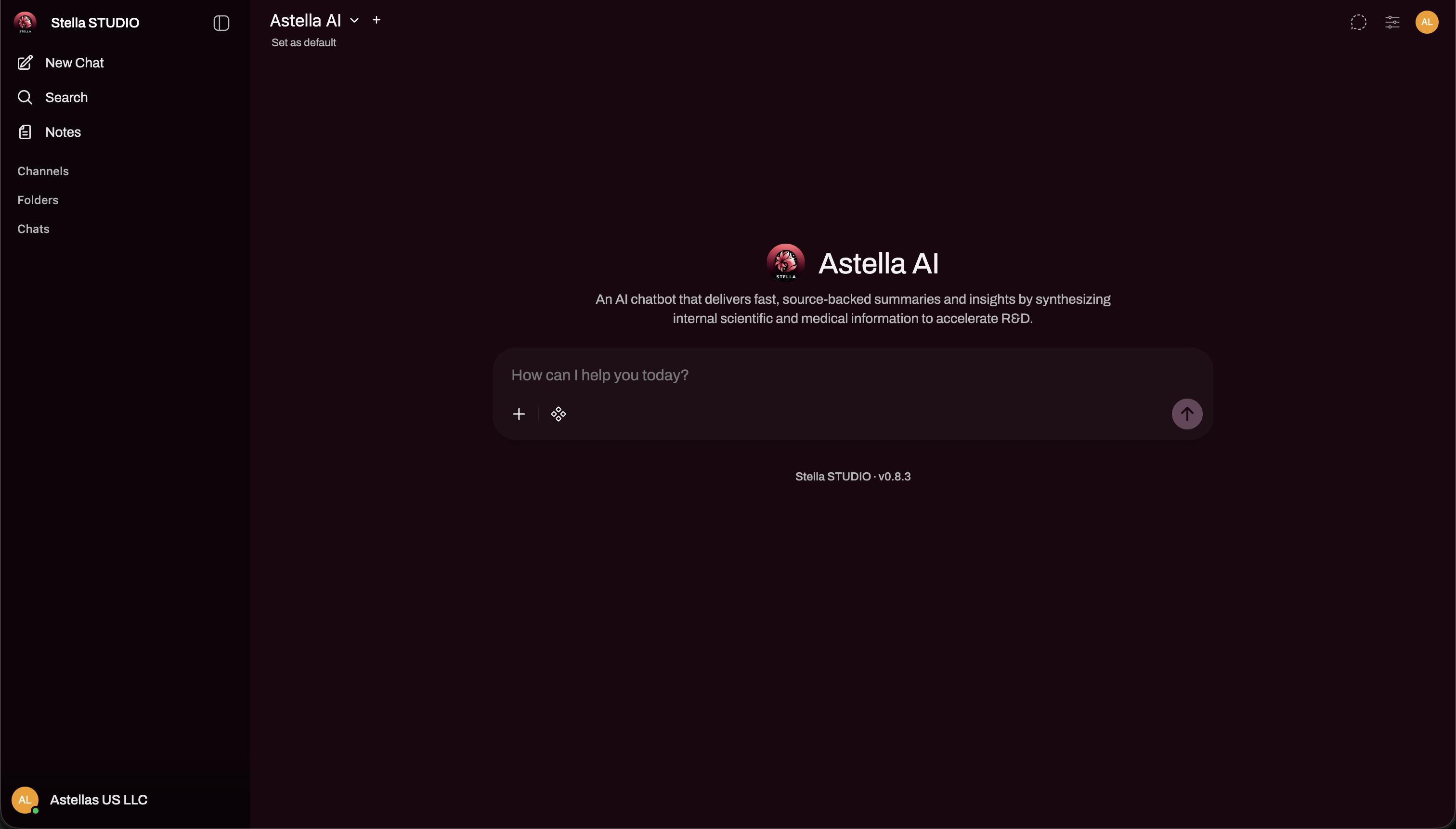
Employees created custom generative AI models tailored to their specific workflows, from research brief templates to regulatory document analysis, without waiting on IT. The platform now hosts 420+ user-built models, a clear signal of organic, bottom-up adoption.
02. Organic Growth & Adoption
The platform grew to 3,200+ total users organically, with an advanced user base exceeding 800, demonstrating strong demand-driven adoption across the organization.
03. Measurable Efficiency Gains
68% of users reported significant efficacy gains in their daily work, with a +43 NPS indicating strong user satisfaction across departments.
04. Research Acceleration
R&D and research teams reported dramatic improvements in gathering and synthesizing scientific information, clinical trial summaries, and multilingual medical documents.
“For coding tasks, efficiency has increased more than ten-fold, I can’t imagine working without this tool now.” Advanced User, Astellas
Top Use Cases
- Drafting and reviewing scientific research briefs for R&D projects
- Summarizing clinical trial reports
- RAG over SOPs and regulatory policy documents
- External information gathering on medical research data
- Translation of multilingual medical documents
- Generating code snippets for data analysis pipelines in research
Integrations
- Microsoft Outlook: AI-assisted drafting and scheduling of responses
- Microsoft Teams: Collaborative AI-powered chat for project discussions
- SharePoint: Secure document ingestion and search within AI workflows
- Internal document management system: Instant retrieval of corporate knowledge base
Why Astellas Chose Open WebUI
- Model freedom: choose, switch, and update models without vendor lock-in
- Custom model creation: employees build and share models tailored to their workflows
- Fine-grained permissions: RBAC and group-based collaboration controls
- Self-hosted flexibility: fully private deployment within Azure
- Deep integration: connects to existing Microsoft ecosystem and internal systems
- Scalable architecture: grew from initial deployment to 3,200+ users organically
Looking for an Enterprise Plan? Speak with Our Sales Team Today!
Get enhanced capabilities, including custom theming and branding, Service Level Agreement (SLA) support, Long-Term Support (LTS), and more!