Role-Based Access Control (RBAC)
Open WebUI implements a flexible and secure Role-Based Access Control (RBAC) system. This system allows administrators to precisely manage user capabilities and access to resources through three interconnected layers:
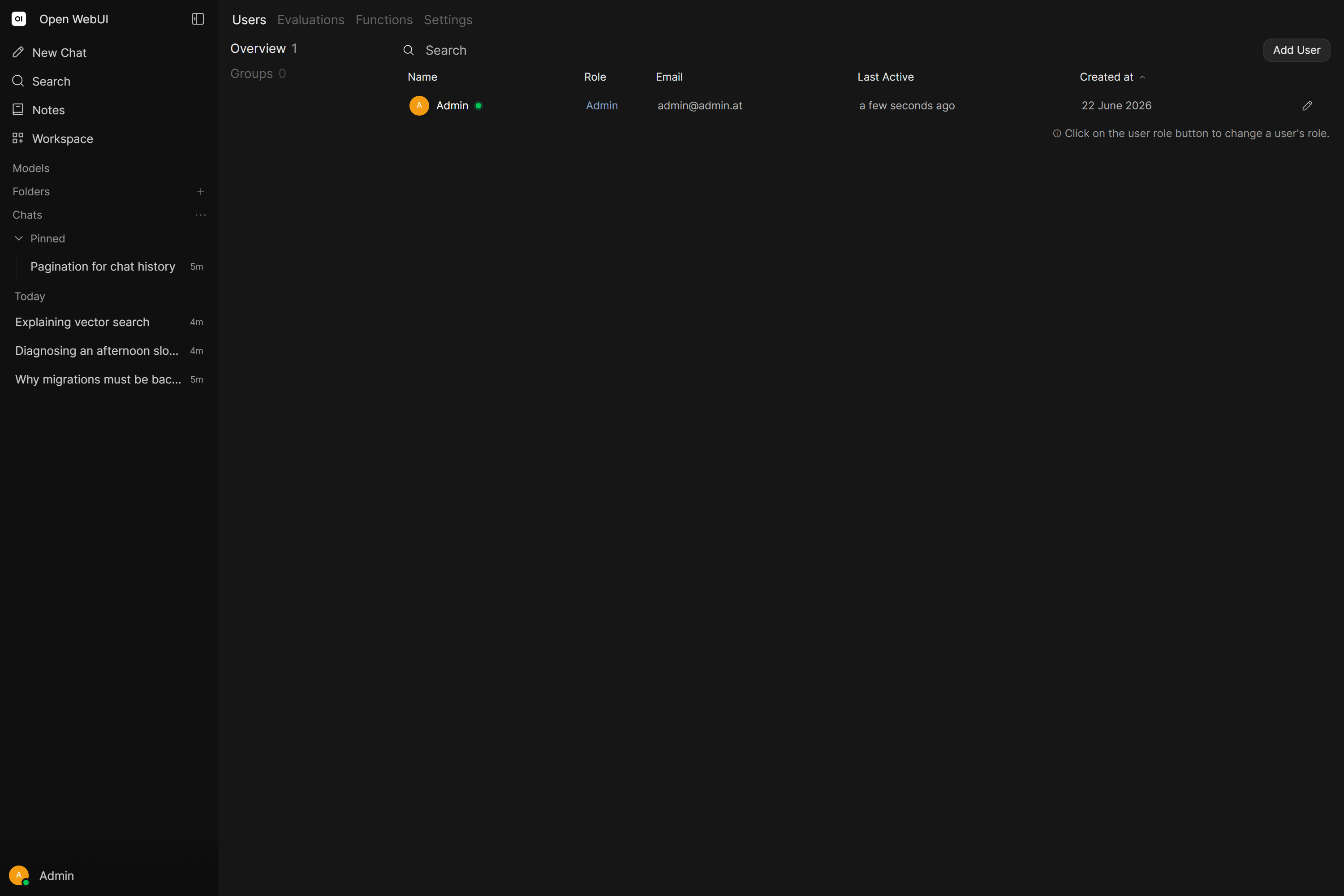
- Roles: The high-level user type (Admin, User, Pending). This defines the baseline trust level.
- Permissions: Granular feature flags (e.g., "Can Delete Chats", "Can Use Web Search").
- Groups: The mechanism for organizing users, granting additional permissions, and managing shared access to resources (ACLs). Resources can also be shared directly to individual users. A group can sit inside another group and inherit its rights (nested groups), and it can set the default models its members start a new chat with.
The security model is Additive. Users start with their default rights, and Group memberships add capabilities. A user effectively has the union of all rights granted by their Roles and Groups.
RBAC controls what users can do inside Open WebUI (features, resources, and UI/API actions).
RBAC does not replace least-privilege configuration for external providers. If you connect an OpenAI-compatible proxy/provider (for example LiteLLM, OpenRouter, or custom gateways), use provider credentials that are scoped for inference usage in your deployment.
Avoid configuring management/master keys for general user traffic unless your deployment explicitly requires that level of trust.
Documentation Guide
-
- Understand the difference between Admins and Users.
- Learn about Admin limitations and security/privacy configurations.
- End every session of a user with Sign out all devices.
-
- Explore the full list of available permission toggles.
- Understand granular controls for Chat, Workspace, and Features.
- Security Tip: Learn how properly configured Global Defaults protect your system.
-
- Learn how to structure teams and projects.
- Strategy: Distinguish between "Permission Groups" (for rights) and "Sharing Groups" (for access).
- Manage Access Control Lists (ACLs) for private Models and Knowledge: share with groups or individual users.
- Put groups inside other groups (nested groups) and set default models per group.