Channels
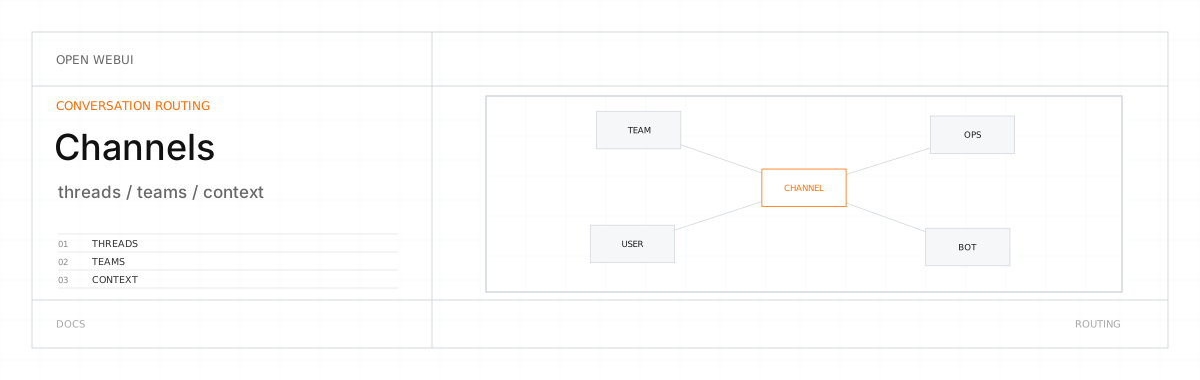
Where your team and AI think together, in real time.
Channels are persistent, shared spaces where humans and AI models participate in the same conversation. Unlike standard chats, which are personal and isolated, Channels let multiple users and multiple models interact in a single timeline. Every exchange, whether human or AI, becomes shared context that the whole team can build on.
Open WebUI is where knowledge is found, created, and shared. Channels make that collaborative.
Why Channels?
AI as a participant, not a separate tool
Tag @gpt-5.6 to draft a plan, then tag @claude to critique it. Your whole team sees both responses in the same timeline with full context. No tab-switching, no copy-pasting between tools.
Persistent shared context
Every message becomes part of the record. When someone asks a question next week, the AI can draw on everything discussed before. Channels are living knowledge bases, not disposable threads.
Multiple models, one conversation
Use one model for code review, another for writing, a third for data analysis, all in the same channel. Chain them together for richer answers than any single model could produce.
Real-time collaboration
Instant updates, emoji reactions, threaded replies, pinned messages, and unread indicators.
Key Features
🤖 @model tagging | Summon any AI model into the conversation on demand |
| 👥 Shared context | Every message, human or AI, builds the collective knowledge |
| 🧵 Threads & reactions | Keep discussions organized with replies, pins, and emoji reactions |
| 📎 File sharing | Drop images, documents, and code. AI can see and process them |
| 🔒 Access control | Public, private, group-based, and direct message channels |
| 🧠 AI channel awareness | Models can search and synthesize across channels autonomously |
Channel Types
| Type | Best for |
|---|---|
| Standard | Topic-based rooms (#engineering, #marketing-strategy), public or private |
| Group | Team-scoped spaces with explicit membership and user-group sync |
| Direct Message | Private 1:1 or small-group conversations with online/offline status |
How It Works
Talking to AI
Channels are passive by default. AI doesn't jump into every conversation. When you need input from a model, just tag it:
You:
@gpt-5.6Here's our Q3 revenue data. What trends stand out?(GPT-5.6 analyzes the data and responds with key insights)
You:
@claudeDo you agree with that analysis? What's missing?
This means your team can discuss freely without AI interrupting, and call on exactly the right model when it's needed.
Where the reply appears
By default a model answering a top-level mention replies in a thread under your message, so a long answer does not push the channel's conversation off the screen. An administrator can change this in Settings > Admin > General (Model Response Mode, or CHANNEL_MODEL_RESPONSE_MODE): set it to Channel and the reply is posted into the timeline instead, where the team reads it without opening a thread. Mentioning a model from inside a thread always answers in that thread either way.
Full chat-completion pipeline
Mentioning a model in a channel runs through the same chat-completion pipeline as a standard chat. The reply is streamed in real time as the model generates it, and the model has access to the full set of capabilities its configuration grants:
| Capability | What it enables in a channel |
|---|---|
| Native and default function calling | Tool calls resolve and execute mid-message |
| Built-in tools | Web search, image generation, code interpreter, calendar |
| User tools and MCP tools | Whatever the model is configured to call, it can call |
| Filters | Inlet/outlet/stream filters apply just like in chats |
| Knowledge (RAG) | Knowledge bases attached to the model are queried and injected |
| Attached documents | Images and non-image files (PDF, DOCX, etc.) uploaded in the thread are forwarded into the model's context |
| Structured replies | The reply is rendered from the model's full output, so reasoning blocks, tool calls, generated images and code results appear in the channel as they do in a chat, rather than being flattened to plain text |
In other words, a channel-summoned model is a fully-equipped agent, not a one-shot completion.
Before v0.9.6, tagging a model in a channel only forwarded images from the thread. Uploaded PDFs, DOCX, and other non-image documents were ignored, so summarization and document-comparison prompts silently had nothing to work with. As of v0.9.6 these files are forwarded the same way they are in a direct chat, so document workflows behave identically in channels.
Tagging people and linking channels
Use @username to notify teammates. The suggestion list puts the channel's own members first, then anyone else on the instance whose name matches what you typed, so you can still tag someone who is not in the channel. Use #channel-name to create clickable cross-references between conversations.
Message interactions
Hover any message to react with emoji, pin it for reference, reply inline, or start a threaded side conversation.
Bots posting as a model
Any account can post into a channel over the API, which is how bot integrations work: the bot runs under its own account and posts like any other member. open-webui/bot is an experimental starting point for building one.
A posted message can carry an optional model identity, and the interface then renders that message under the model's name and avatar in place of the posting account's. A bot that answers on behalf of a model sets this so its replies are presented as that model's replies.
That identity is a label chosen by whoever posts the message, and it is not evidence that the server ran the model. The account that posted stays the recorded author and is what the API returns for the message, so the real sender can always be recovered. Anyone who can post in a channel can set the label, so treat the model name next to a message as presentation only.
Direct messages
A direct message is a conversation between you and the people you pick, and there is one of them per set of participants. Start one from the Message button on someone's profile card in a channel, or from (+) in the sidebar's Channels section with Channel Type set to Direct Message. Messaging someone you have messaged before reopens the conversation you already have with them, with its history, instead of adding a second one beside it. A name is optional on a direct message; without one it is listed under the names of the other participants.
Membership is measured against the accounts that still exist. When someone's account is deleted, they stop counting towards the conversation: they are gone from the member list and from the member count next to the people icon in the header, and the participants who remain still land back in that same conversation when they message each other again. Group channels count their members the same way. Nothing merges two conversations that already exist for the same set of people, so where a duplicate was created it stays in the sidebar alongside the original, with the messages that were sent in it.
AI Channel Awareness
With native function calling enabled, models can navigate your channels autonomously:
- Search channels by name or description
- Search messages across all accessible channels
- Read threads to understand full discussion context
You: What was decided in
#dev-teamabout the migration timeline?(The AI searches the channel, reads the relevant thread, and gives you a synthesized answer, all without you leaving your current chat.)
This removes the need to manually bridge information between private chats and shared channels. The AI does it for you.
If you want a one-click path from a chat message into a channel, the community Forward to Channel action adds a button to each assistant message that posts the reply (or a selection) into a channel of your choice. Useful for promoting good answers from private chats into team-visible spaces without copy-paste.
Getting Started
Channels must be enabled by an administrator before use.
- Navigate to Settings > Admin > General
- Toggle Channels on and save
- Channels appear in the sidebar. Click (+) to create your first one
Creating a standard channel is restricted to administrators. Someone with the Channels permission (USER_PERMISSIONS_FEATURES_CHANNELS) can create group channels and direct messages. Channels support granular permissions including read-only access, write access, and feature-level toggles via environment variables or group permissions.
Use Cases
Team knowledge hub (#engineering)
Your team discusses architecture decisions throughout the week. Someone tags @claude to evaluate tradeoffs. The AI's analysis becomes part of the permanent record: searchable, referenceable, and available to every future conversation in that channel.
Multi-model war room (#incident-response)
Paste logs and error traces. Tag @gpt-5.6 to analyze the stack trace. Tag @qwen3.6 to suggest a fix. Tag @claude to draft the postmortem. Three models, one shared context, one timeline.
Project strategy (#product-launch)
Twenty messages of human brainstorming. Then: @gpt-5.6 Read the conversation above and create a prioritized action plan with owners and deadlines. The AI synthesizes everything discussed into a structured deliverable.
Creative collaboration (#story-mode)
Long-running narrative projects where multiple "character" models interact in the same timeline. Switch between personas without losing context.
Public channels are visible to all users on your instance. Do not share API keys, passwords, or sensitive data in public channels.