History & Search
Open WebUI provides a powerful system for managing and navigating your previous conversations. Whether you are looking for a specific snippet of code from last month or trying to organize hundreds of chats, the history and search features help you find your data quickly.
Chat History Sidebar
All your conversations are automatically saved in the Sidebar.
-
Persistence: Chats are saved to the internal database (
webui.db) and are available across all your devices. -
Organization: Chats are grouped by time period (Today, Yesterday, Previous 7 Days, etc.).
-
Hover Preview: Resting the pointer on a chat opens a small card with its most recent messages, so you can tell conversations apart without opening them. Switch it off with Chat Hover Previews in Settings > Interface > Chat if you want a quieter sidebar, are sharing your screen, or are on a connection slow enough that the previews lag. Previews need a pointer, so they do not appear on a touchscreen.
-
Unread Indicator: Chats with new activity show an unread dot in the sidebar until you open them. A chat's three-dot menu has Mark as unread to put the dot back; a folder's menu, and the Chats section header's own menu, both have Mark all as read to clear a folder or your whole chat list in one go.
-
Renaming: Titles are automatically generated by a task model, but you can manually rename any chat by clicking the pencil icon next to its title. The automatic title is written without counting as activity, so a chat is not pushed back to the top of the list, or marked unread again, just for being named.
-
Archivial: Instead of deleting, you can Archive chats to remove them from the main list. Archived chats are left out of search unless the query includes
archived:true, and stay browsable under Settings > Archived Chats. -
Folder Unread Count: A folder shows how many unread chats it holds, counting its subfolders too. See Folders & Projects.
-
Opening and Closing: The sidebar slides in and out. Your chats are loaded once when you open Open WebUI, not again each time you show the sidebar, so hiding it and bringing it back keeps everything you had already scrolled into view instead of dropping you back at the newest chats.
Open WebUI tracks read state per chat and updates it when you open a conversation, so unread indicators stay in sync across sessions. Opening a chat clears its unread mark, and the folder counts, in your other open windows right away.
Searching Your History
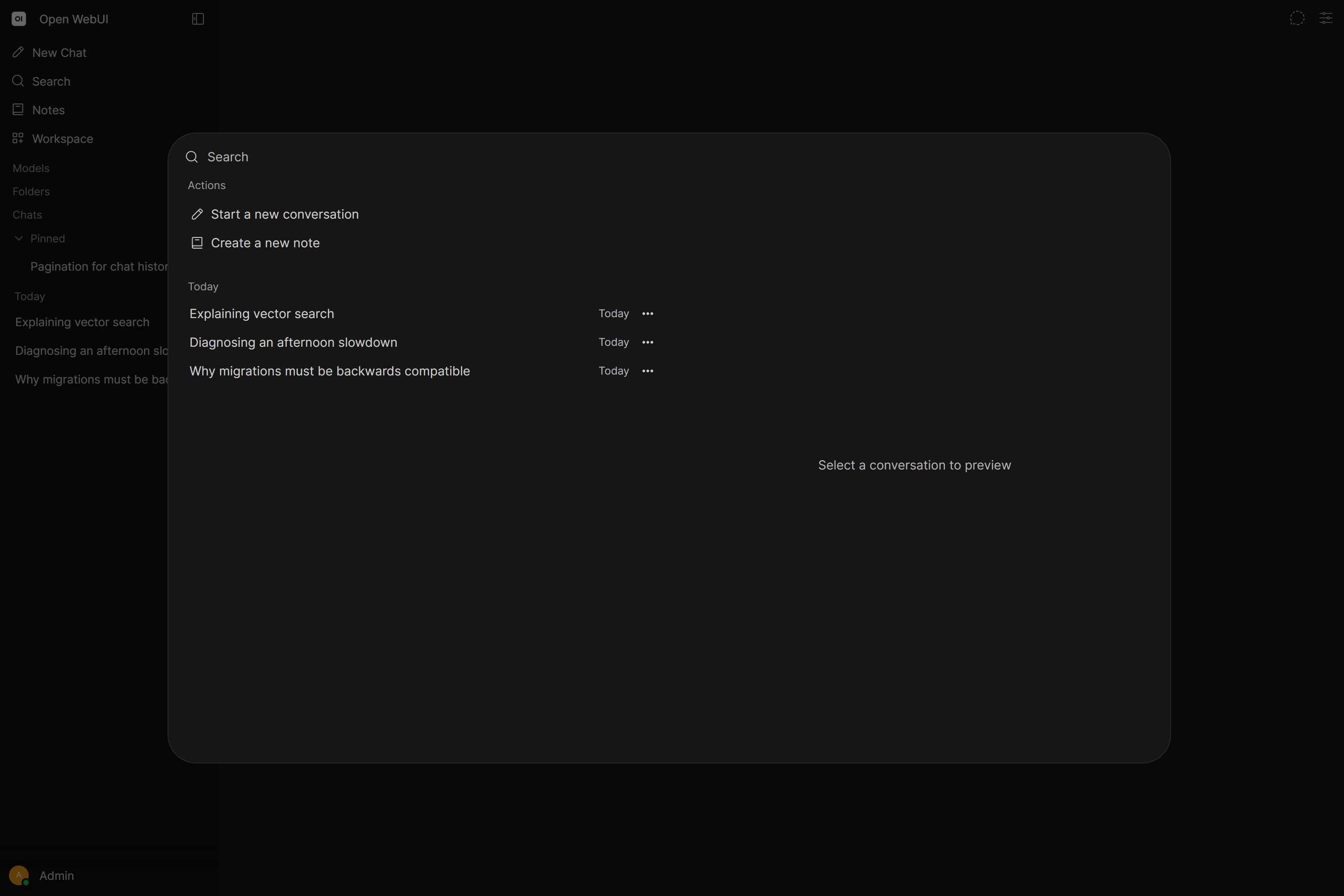
You can search through your conversations using the global search bar in the sidebar.
- Click the Search icon or use the keyboard shortcut
Cmd+K/Ctrl+K. - Type your query. Open WebUI searches across:
- Chat Titles
- Message Content
- Tags (Search using
tag:my-tag-name)
- Click on a result to immediately jump to that conversation.
How queries are matched
A query of several words finds every chat that contains all of them, in any order, without needing them next to each other. Each word can come from the chat's title or from any of its messages, and different words can come from different messages, so docker healthcheck also finds a chat titled "Docker setup" whose reply mentions a healthcheck. Chats that contain your query as an exact phrase are listed first, then the rest, each group ordered by most recently updated.
Matching ignores case and works on substrings, so log also matches "login" and "backlog". Words are cut out of your query on English letters and digits, so v0.9.1 searches for v0, 9 and 1 separately. A query written entirely in another script, Chinese or Russian for example, is searched as one exact phrase.
Filter prefixes
You can narrow results with filter prefixes, alone or combined with a query:
tag:<name>, chats with a given tagfolder:<name>, chats in a folderpinned:trueorpinned:false: only pinned chats, or only chats that are not pinnedarchived:trueorarchived:false: only archived chats, or only chats that are not archivedshared:trueorshared:false: only chats with a share link, or only chats without one
The last three need true or false after the colon. Typed on their own, pinned:, archived: and shared: are dropped from the query and filter nothing.
For example, folder:work meeting notes searches for "meeting notes" within the work folder. Matching results show a short snippet of the matched message, taken from wherever the match was found: the whole phrase if the chat contains it, otherwise the first of your words that turns up in a message. A chat matched only on its title shows no snippet. Highlighting inside a snippet is applied only when your whole query appears in it, so a result found by a single word is shown unhighlighted.
Native Conversation Search (Agentic)
When using a model with Native Function Calling enabled (see the Central Tool Calling Guide), models can search through your chat history autonomously.
Available History Tools:
search_chats: Text search across chat titles and message content, using the same matching as the search bar and skipping the chat the model is currently in. Returns matching chat IDs and snippets.view_chat: Reads and returns the full message history of a specific chat by ID.
Why use native tool calling for Search?
This allows the model to leverage its own previous work. You can ask: "What was the feedback I got on my last email draft?" or "Find the Python script I wrote about image processing two weeks ago."
The model will search your history, identify the correct chat, read it, and provide you with an answer or the code you were looking for, saving you the effort of manual scrolling and copy-pasting.
Data Management
- Export: You can download individual chats or your entire history as JSON, plain text (.txt) or PDF. The whole history exports as JSON only. There is no Markdown export.
- Import: Drag and drop a JSON chat export into the sidebar to restore it.
- Deletion: You can delete a single chat from its three-dot menu in the sidebar, from the menu at the top of the chat itself or from a search result, and clear your entire history with Delete All Chats in Settings > Data Controls.
Deleting needs the Chat Delete permission. Where an administrator has taken it away, none of those delete controls are drawn, so you no longer meet a delete button that refuses when you press it. Archiving is unaffected, and admins are always exempt.